Don't miss our holiday offer - up to 50% OFF!

Search Engine Marketing (SEM) in Business Growth

SEM in digital marketing is one of the vital and core components of digital marketing and what every business that wishes to have a sustainable online presence must engage in.
What is SEM? This means Search Engine Marketing. It is the kind of e-marketing where Google and other search engines are paid to display your business on the first page of the Search Engine Results Page (SERP). It is closely similar to SEO, but the main difference is that, for SEO, your website page appears by merit or organically, while SEM requires you to pay a certain amount.
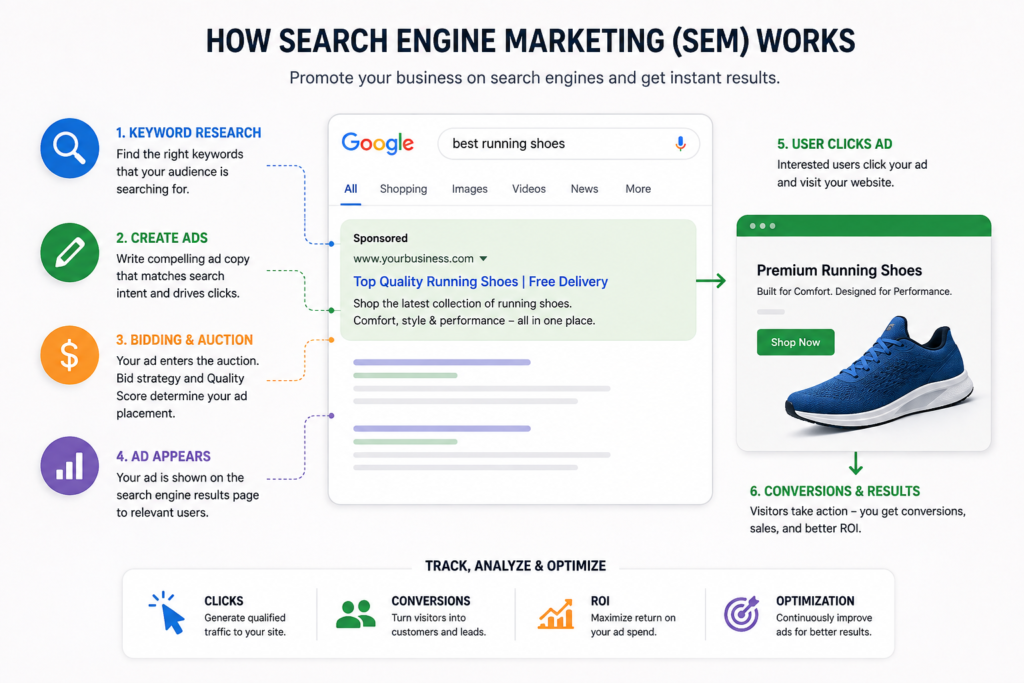
For SEM, the advertiser (business owner) does their research on the best keywords they would like to rank for. They then pay Google to have their businesses shown to searchers when these keywords are searched by users. Through this, their businesses are displayed to millions of people searching for something they are selling.
As we dive deeper into SEM, I will be discussing all the basic things revolving around it and highlighting some of the best practices for successful business growth.
Why is SEM Important?
SEM is important because it is an ad that is placed based on what people are searching for. What this implies is that advertisers or business owners can easily display their businesses to their target audience.
For instance, as a digital marketer who provides services to small and medium businesses, looking to reach out to my target audience, I can easily target someone searching for something on digital marketing. For me, I would display my ads to someone searching for “best digital marketer around me”.
Also, an online business selling shoes will target someone searching for something similar like “where to buy the best shoes”.
The implication of this is that you can easily target someone who has the intention of buying what you sell, and this is why keyword research is important to improve your conversion rate, which is why you need a professional to handle your digital marketing processes.
How SEM Works
I have talked a little about how SEM works. The basics are that you pay search engines to put your business on the front page of their SERP. However, it must be noted that it is not all it is.
Several business owners like you would also like to take that ad space. Therefore, it becomes competition between the advertisers, and NO, Google will not just put your adverts out simply because you paid.
When different businesses wish to get their ads shown, we call this process bidding, which is just the amount each person is willing to pay for ads to show. However, it is not a matter of who pays more because search engines also look at credibility and value.
All search engines want to give their users the best, so it only makes sense to not only think about the money you pay but also values and credibility.
Once your ad is shown, there is also a separate amount you pay for every customer that clicked on the ads into your website or online business store. This is what we call Pay Per Click (PPC).
Things to Consider for a Great SEM Campaign
Getting the best out of every click is important to make every penny paid count. Remember, it’s not about having millions of people onto your website or online store; it’s about getting them to buy what you are selling.
1. Set Clear and Reasonable Goals
2. Conduct Thorough Keyword Research
3. Use Keyword Match Strategically
4. Optimise your landing page
5. Allocate Budget Effectively
6. Connect measuring tools
7. Conduct A/B testing
1. Set Clear and Reasonable Goals
Setting the goal of the campaign is the first step in running a successful campaign. What do you want to achieve? This must be clear. Do you want to make sales? Is website traffic more important or are you doing the campaign just for brand awareness? Once the goal is clear, it will help you carry out the ads campaign in the most effective way possible.
2. Conduct Keyword Research
After being clear about the goal, the next stage is keyword research. The goal will determine the keywords to target. For an ad for increasing sales/leads, you will want to target keywords with buying intent; for brand awareness, you can target broader keywords. Therefore, to achieve your goal, the keywords must match the goal.
3. Use Keyword Match Strategically
Using the keyword match in SEM can help target the right audience. Using exact, phrase, and broad match where appropriate can help reach relevant keywords.
4. Optimise Landing Page
You must reduce your bounce rate as much as possible. The landing page must also be easily accessible. For instance, for ads that target increase lead, the landing page must get the visitors to buy within just 3 clicks. Buyers have zero patience, and they can easily close your website, move to another website and never come back. Therefore, a well-optimised landing page helps reduce this and increase your sales.
5. Allocate Budget Effectively
How much is a visitor worth for the ads campaign? You must place value on this to not overpay for ads. Remember, with SEM, you are paying Google to put your website or online store on the front page of the SERP; therefore, every penny spent must be worth it. So, you need to set clear limits on value and ensure the amount paid for ads does not exceed this limit.
6. Connect Measuring Tools
The customers’ journey from the ad to your website and beyond must be measured effectively. This is where GA4, Google Console, Google Tag Manager and other tools come in handy.
7. Conduct A/B testing
Continuously optimising your ads is very important to maintain their success. This can involve experimenting with different “call to action” buttons, testing different ad headlines and descriptions, and monitoring the outcome of each to optimise your ad campaign
Final Words
SEM in addition to other digital marketing strategies, can become the boost your business needs. In another article, I will write extensively about making the ads and share some of the best practices for PPC ads in SEM.
Remember that SEO and SEM, though similar, are not the same. SEO is organic and the visibility your website gets just by providing value. But with SEM, you have to pay to get your website at the top of the SERP.
[…] biggest difference is user intent. Search Ads generally reach people when they are actively searching for products, services or information. […]