Don't miss our holiday offer - up to 50% OFF!
Google Display Ads: The Complete Guide to Display Advertising

Google Display Ads can put your business in front of potential customers while they browse websites, use apps, watch videos and interact with Google-owned platforms. Unlike Google Search Ads, which primarily reach people actively searching for something, Display Ads can introduce your brand to people before they are ready to search.
For businesses looking to build awareness, generate leads, drive sales or reconnect with previous website visitors, Google Display advertising can be a powerful part of a wider digital marketing strategy.
At eGrowthHQ, we believe successful Display advertising is not simply about putting an attractive banner in front of as many people as possible. It is about combining the right audience, creative, message, landing page, bidding strategy and measurement to turn impressions into meaningful business results.
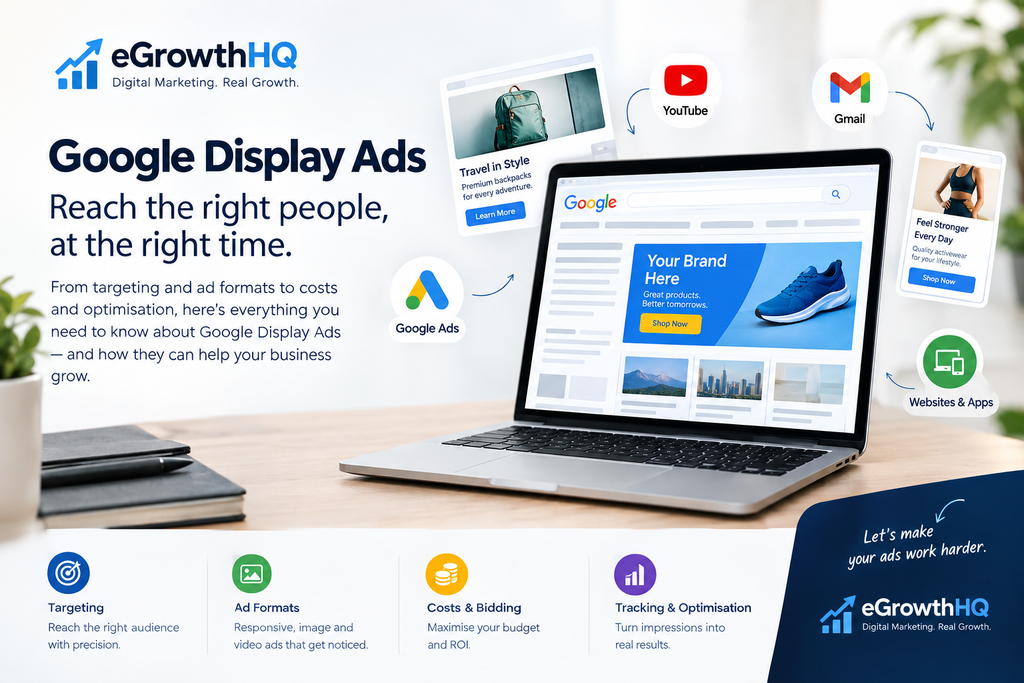
What Are Google Display Ads?
Google Display Ads are visual advertisements that appear across Google’s Display Network and other eligible Google properties like websites, apps, Gmail, and YouTube. They can reach people while they browse millions of websites and apps, as well as on platforms such as YouTube and Gmail.
This makes Display advertising different from Search advertising.
For example, someone searching Google for “accountant near me” is actively expressing an immediate need. A Display campaign might instead show an accounting firm’s advert to someone who fits its target audience while that person is reading an article or using an app.
Display advertising therefore works particularly well for:
- Brand awareness
- Product and service promotion
- Lead generation
- E-commerce sales
- Remarketing
- Reaching new audiences
- Supporting customers throughout the buying journey
How Does Google Display Network Work?
The Google Display Network, often called the GDN, connects advertisers with audiences across websites, apps and other digital environments.
Google uses information such as your campaign settings, audience signals, contextual information and other available signals to determine where and when your ads can appear. Advertisers can use audience segments, keywords and other targeting signals to help Google identify relevant users and content.
This gives businesses significantly more reach than relying exclusively on people who type keywords into Google Search.
However, greater reach does not automatically mean better performance. Poor targeting can result in impressions and clicks from people who have little likelihood of becoming customers. This is why campaign strategy and ongoing optimisation matter.
What Types of Google Display Ads Are Available?
One of the main formats is the Responsive Display Ad.
With responsive ads, advertisers provide assets such as:
- Headlines
- Descriptions
- Images
- Logos
Google then combines these assets into different advertisements and adjusts their size and appearance to fit available advertising spaces.
Advertisers can also use uploaded image ads when they need greater creative control.
For responsive Display Ads, Google recommends high-quality images in different formats. Recommended image dimensions include 1200 × 628 for landscape, 1200 × 1200 for square and 900 × 1600 for portrait images.
The important point is that creative should not be treated as an afterthought. Your image, headline and offer need to communicate value quickly because users are often encountering the advert while doing something else online.
How Does Google Display Ads Targeting Work?
Targeting is one of the most important parts of a Display campaign.
Depending on your campaign and settings, you can use audience segments and other targeting signals to help reach relevant people. Examples include people who have previously interacted with your website, people interested in particular products or services, and people who fit particular demographic or behavioural characteristics.
Your data and remarketing
One particularly useful strategy is reaching people who have already interacted with your business.
For example, an online clothing store could show adverts to someone who visited a product page but did not purchase. The objective is not simply to generate another impression; it is to bring a potentially interested customer back to the website.
Contextual targeting
Display advertising can also consider the content or context in which an advert appears.
For example, a company selling accounting software may want its advertising to appear alongside content relevant to small-business finance and accounting.
Optimised targeting
Google also provides AI-powered targeting options designed to help campaigns find additional users who are likely to convert. Advertisers can provide targeting signals while allowing Google’s systems to identify potentially valuable audiences.
The best approach depends on the campaign objective, available conversion data and how much control the advertiser needs.
How Much Do Google Display Ads Cost?
There is no single fixed price for Google Display Ads.
Your advertising cost depends on factors such as:
- Competition
- Target audience
- Location
- Campaign objective
- Bidding strategy
- Ad quality and relevance
- Available advertising inventory
- Conversion performance
Google Ads allows advertisers to set an average daily budget and choose from different bidding approaches. Depending on the campaign objective, options can include strategies such as Maximise Conversions, Target CPA, Maximise Clicks and Viewable CPM.
The important question is therefore not simply, “How cheap can I make my clicks?”
A better question is: How much does it cost to generate a valuable customer or lead?
A campaign with a higher cost per click can still be more profitable if it generates better-quality customers. Therefore, it is important to target the right customers and also decide before the campaign what the worth of your potential customers would be when they arrive.
Google Display Ads vs Google Search Ads
The biggest difference is user intent. Search Ads generally reach people when they are actively searching for products, services or information. Display Ads can reach people while they are consuming online content, meaning the advertiser can create demand and awareness before the customer actively searches.
For example: Search: “Buy running shoes UK”
Display: An advert from a running-shoe company appears while someone is reading an article about running.
This is why Display and Search should not necessarily be viewed as competitors. A well-planned digital marketing strategy can use both.
Display can create awareness and nurture potential customers, while Search can capture people when they demonstrate stronger purchase intent.
How to Create Effective Google Display Ads
An effective Display campaign starts with the customer rather than the advertisement. Before creating your campaign, establish:
Who are you trying to reach?
What problem are you solving?
Why should they choose your business?
What action do you want them to take?
Your creative should then communicate that value clearly. Google recommends using clear, compelling headlines and descriptions, high-quality images and relevant landing pages. It also advises advertisers to avoid misleading graphics, excessive text overlays and poor-quality imagery.
Your landing page is equally important.
If your advertisement promises a discount, the landing page should clearly present that discount. If your advert promotes a particular service, users should be taken directly to the relevant service page rather than a generic homepage.
This alignment between advert → landing page → conversion can have a major impact on campaign performance.
What Metrics Should You Track?
Getting thousands of impressions does not necessarily mean your campaign is successful.
Important metrics can include:
- Impressions
- Click-through rate (CTR)
- Cost per click (CPC)
- Conversions
- Conversion rate
- Cost per conversion
- Return on ad spend (ROAS)
- Viewable impressions
- Engagement and assisted conversions
The correct metrics depend on the campaign objective.
A brand-awareness campaign may focus more heavily on reach and visibility, while an e-commerce campaign may prioritise purchases, revenue and ROAS.
Conversion tracking should therefore be established before making major optimisation decisions. Google recommends regularly checking conversion tracking to ensure conversions are being recorded correctly.
Common Google Display Ads Mistakes
Many businesses waste advertising budgets because they focus on launching campaigns rather than managing them.
Common mistakes include:
Targeting too broadly
More impressions are not necessarily better. Reaching irrelevant users can consume budget without producing meaningful results.
Using weak creative
Blurry images, generic messaging and unclear calls to action can make an advert easy to ignore.
Sending everyone to the homepage
A user clicking an advert about a specific product should ideally arrive on a page relevant to that product.
Ignoring conversion tracking
Without reliable conversion data, it becomes difficult to understand which audiences, creatives and campaigns are actually producing business results.
Focusing only on clicks
A large number of clicks can look impressive while generating very few customers. Optimisation should ultimately connect advertising activity to business outcomes.
Are Google Display Ads Still Worth Using in 2026?
Yes, but advertisers need to understand how Google’s advertising products are evolving.
Google announced in 2026 that Display campaigns are moving toward Demand Gen, with eligible advertisers able to voluntarily migrate existing campaigns from June 2026 and further migration planned.
This makes it particularly important for businesses to avoid relying on outdated Display advertising advice.
The underlying principle, however, remains the same: successful visual advertising requires a clear objective, relevant audience, strong creative, appropriate landing pages and reliable measurement.
How eGrowthHQ Can Help With Google Display Advertising
Running Google Display Ads is easy to start. Running them profitably requires considerably more thought.
At eGrowthHQ, we approach paid advertising as part of a complete digital marketing system rather than an isolated source of clicks.
That means looking at the entire customer journey:
Audience → Ad → Landing Page → Conversion → Customer → Measurement → Optimisation
We can help businesses develop Display advertising strategies, identify appropriate audiences, create compelling ad messaging, improve landing-page alignment, analyse campaign performance and continuously optimise campaigns around meaningful business objectives. The goal is not simply to make your business visible.
The goal is to make your advertising work.
See also: Search Engine Optimisation
Final Thoughts
Google Display Ads can help businesses reach potential customers beyond traditional search results, build brand awareness, generate leads and support sales throughout the customer journey.
But successful Display advertising is not about spending more money or generating the highest number of impressions.
It is about reaching the right people with the right message at the right time, then measuring what happens after the click.
For businesses willing to combine good creative, intelligent targeting, strong landing pages and continuous optimisation, Google Display advertising can become a valuable part of a wider digital marketing strategy.
If you’re unsure whether Display advertising is right for your business, the best place to start is not with an advert.
Start with your objective, your customer and the result you want your advertising to produce.