Don't miss our holiday offer - up to 50% OFF!

E-Commerce Customer Acquisition Strategy

How to Build an E-Commerce Customer Acquisition Strategy
Acquiring customers for your e-commerce business is one of the most important parts of your business; therefore, you need the best strategy that works for you.
For a B2C business, especially using an e-commerce website, turning website visitors into customers is very daunting. It can also be expensive, especially if you’ve already spent a lot on marketing.
Therefore, in this article, I am going to be walking you through the best strategies which I am certain that if it is followed, would deliver a great customer acquisition strategy for your business no matter its scale.
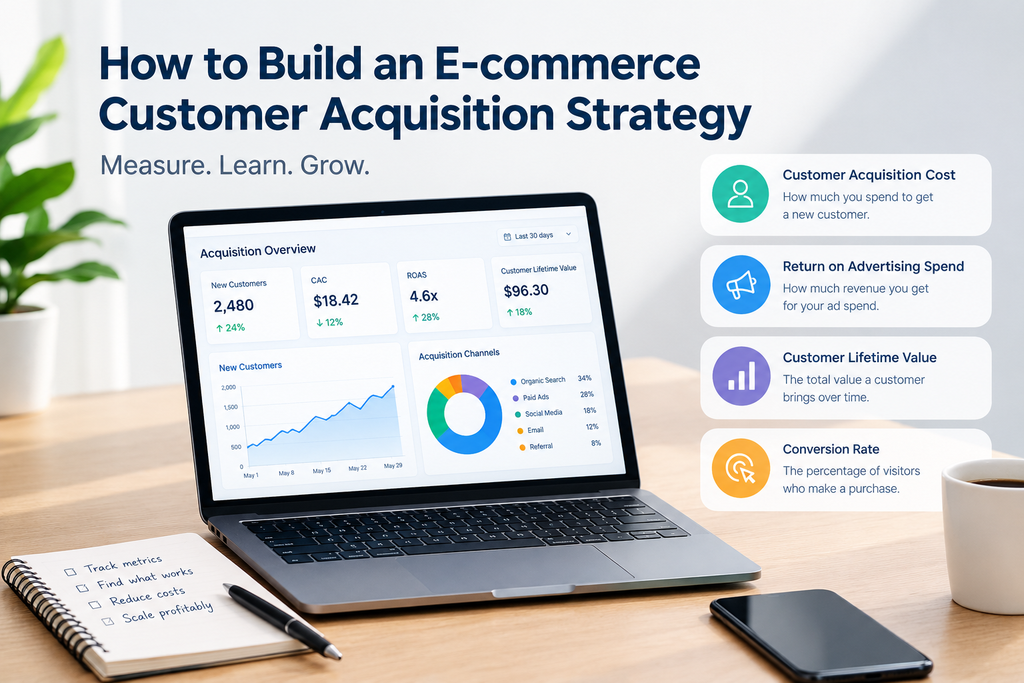
What does customer acquisition mean?
Customer acquisition is the act of turning a website visitor into a buyer and subsequently a returning customer. When a user sees your website and your business for the first time, they have just a few seconds, maybe minutes at best, to decide if they want to buy or not. The process of making random internet users stumble upon your website is marketing. They only become customers after they have bought and returned to buy again.
See Also: Google Display Ads
Why is customer acquisition important for online/e-commerce stores?
It is simple: to make a profit, there must be revenue, and there will only be revenue when there are sales. Therefore, customer acquisition is the bedrock on which every business stands. The survival of a business is dependent on a smart and profitable strategy you have adopted and consistently optimised to serve your online store. Other benefits are:
- It helps marketers identify which channels bring in customers.
- It allows businesses to assess whether their marketing costs are worthwhile.
- It supports business growth by making customer acquisition more efficient.
Steps for Customer Acquisition
Define your Target Audience
Knowing your target audience is the first step to a successful digital marketing campaign. It is not enough to push digital ads out, but to push them to the right audience. Therefore, you need to define this and be clear about it. Who are your ideal customers? How old are they? What gender of people uses your product more? What race or ethnicity do they come from, or which country or area do they reside in? These are vital questions you need to answer to specifically define who your target audience is.
To rightly define your audience, you need to have good knowledge of your business. This is basic to help you kickstart your marketing campaign to the right people. Data from these campaigns can then help you understand your audience more, properly define them and improve your customer acquisition.
Set Your Customer Acquisition Budget
You should not overpay for ads and that comes from the knowledge of what profit you get from a single purchase on your e-commerce website. You should make a profit; therefore, overpaying for the value of customers on your website is not a good option as an e-commerce business owner.
It should be noted that setting the correct budget does not start at the early stage of your advertising campaign. It takes a series of iterations to know the value of every visitor sent to your website to properly set a good and profitable budget.
As a rule of thumb, I always advise new business owners not to set a high budget. It is better to experiment with a small budget, iterate over a period and optimise properly before going big with your budget.
Calculate your target acquisition cost
Calculating your acquisition (CAC) cost is simple. It is simply the quotient of total acquisition cost and the number of new customers.
CAC = (Total Acquisition Cost) / (Number of New Customers)
If you spent $1000 on Search Engine Marketing and it generated 2000 website visitors. Out of these 2000 website visitors, we assume you had a 5% conversion, which means 100 people bought something from you. Then the cost of acquisition is calculated as below:
CAC = 2000/100
CAC = $20
This means you have spent an average of $20 on acquiring new customers. Therefore, you must be assured that this is worth it for your business and that the profit generated from every purchase is greater than this value.
Choose Your Customer Acquisition Channels
Where is your target audience, and what type of marketing will reach them quicker? This is important, and it boils down to understanding your audience. Are they people actively searching for something on search engines? Then maybe search engine optimisation will be the best channel, or search engine marketing. If they are youths with a constant social media presence, then you may want to consider a social media display ads campaign. Therefore, it is important to understand your customers and rightfully target them.
Also, you do not have to choose only one channel. There are several digital marketing channels, and the right blend of them can give you the best results. Marketing involves A/B testing, and you may have to run different ad campaigns to properly understand what works best for your online customer acquisition.
Convert Website Visitors into Customers
Getting users into your e-commerce website is one thing, and turning them into customers is another challenge you have to face as an e-commerce business owner. You need to understand that people are very impatient, and just a little thing can make them close your website and not return. Therefore, it is important to keep them on your page by properly optimising your landing page. Below are some important things you should consider doing to your website to reduce bounce rate.
- Improve your website opening speed: People don’t have much time to wait for a slow website. Ensure your website is optimized in speed and should not take more than 4 seconds to land on your page.
- Improve the UI/UX: What is the arrangement on your website, and how long will it take for anyone to look through it and understand what to do to make a purchase
- Conduct A/B testing: You need to experiment a lot with different features to understand what users love best. It could be the size of the ‘order’ button or the title of the page. Experiment and use the data you get to properly optimise.
Measure Your Results
Measuring results depends on the goal of your marketing campaign. For a goal that involves awareness, a good result can be measured by just the number of website visitors. However, since this article is focused on customer acquisition, results are beyond website visitors. Rather than focusing only on website traffic, social media engagement or the number of clicks on advertisements, businesses should track metrics that show how effectively they attract new customers and convert them into paying customers.
There are several ways to measure results:
- Customer Acquisition Cost (CAC)
- Return on Advertising Spend (ROAS)
- Customer Lifetime Value (CLV)
- Conversion Rate
Optimise and Improve Your Strategy
It is important that marketing data is used to consistently optimise campaigns until the optimum result is achieved for the business. The first marketing campaign can be done based on just the knowledge of the business. However, after results are gotten, the data must be used to make decisions for the subsequent ads. This can include knowing the best acquisition channel, the best ads suitable for the business and even the best time to run an ad campaign. These are gotten from the data and can guide you through making informed decisions.